
What happens to digital when NHS trusts come together
HPN South took place on 15–16 October 2026 at the Radisson Blu Edwardian Hotel, Heathrow.
A clinician in North West London can arrive at another hospital, open the same clinical system and sign in with the same details - but still be unable to get through the door because their access card does not work.
"The computer system is the same, their login is the same, but they cannot get through the door."
Robbie Cline
It was a small detail, but it captured one of the biggest challenges facing NHS groups. Bringing organisations together on paper is one thing. Making it possible for people, information and services to move easily between them is another.
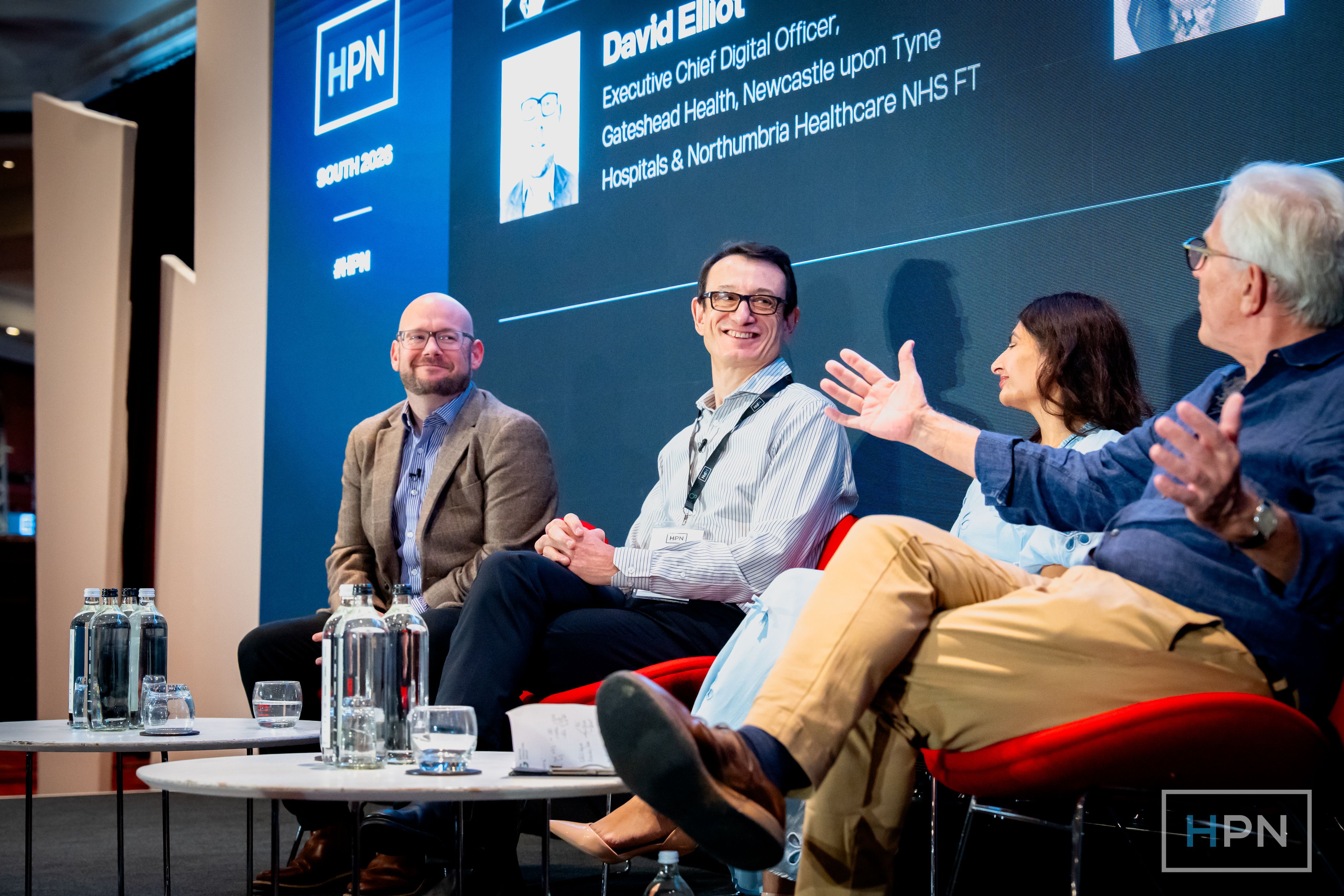
That gap between the ambition and the operating reality shaped a lively opening discussion at HPN South. Chaired by Sir David Sloman, the panel brought together three digital leaders whose organisations are taking very different routes towards working at scale.
David Elliott spoke from the perspective of the Great North Healthcare Alliance, which connects three Gateshead Health, Newcastle upon Tyne Hospitals and Northumbria Healthcare. Ravi Kaur Sahota shared the experience of Dudley and Sandwell and West Birmingham, two statutory trusts operating with one board, one executive team and a shared digital plan. Robbie Cline brought the view from the North West London Acute Provider Group, where much of the digital convergence began before the group itself was formed.
Their stories challenged the idea that there is one route to digital convergence - or that convergence should always mean putting every trust onto the same system.
Three groups and three different starting points
The Great North Healthcare Alliance has inherited three markedly different digital estates. One trust has built its own electronic patient record, another uses a large commercial EPR and the third has a wider mix of systems. Faced with that complexity, Elliott's starting point is not a wholesale technology replacement. It is finding the areas where working together can deliver value now: infrastructure, cyber security, shared Wi-Fi and patient pathways that cross organisational boundaries.
"The cultural bit is probably the hardest bit to tackle. Everybody wants the best for patients, and that is where we have to start."
David Elliott
The West Midlands group is more formally integrated, but that has not removed the need for local decision-making. Dudley and Sandwell and West Birmingham share leadership and strategy, while operational teams remain rooted at each site. The trusts also have two different EPRs, with no current plan to replace them with a single platform. The priority is to create parity around them through shared infrastructure, data capabilities and better interoperability.
North West London came at the question from the other direction. Its trusts had already been moving towards shared clinical systems and an integration platform before the provider group took shape. That foundation has made it easier for clinical teams to work together, but Cline's example of the access cards showed why a common system is not the same as a common working environment. Some of the hardest barriers now sit outside digital altogether, in employment arrangements, finance, estates and corporate services.
The contrast between the three models moved the conversation away from the idea of a perfect structure and towards a more practical question: where will consistency improve care, and where would it simply replace one set of problems with another?
The real prize is capability
When the speakers described what scale had made possible, the benefits were clear. Groups can share project managers, architects, cloud and integration specialists, strengthen their response to cyber incidents and build expertise in emerging areas such as AI without asking every trust to create a separate team.
There are financial gains too. Elliott described one shared-system project where collaboration reduced the expected cost by around £12 million. In the West Midlands, the two trusts are testing different uses for ambient voice and AI-supported triage, then sharing the evidence across the group rather than running the same work twice.
But the panel was equally clear that scale does not rescue poor foundations.
"When we benchmarked our digital projects, 70% of the success relied on doing the basics right."
Ravi Kaur Sahota
For Sahota, those basics include reliable infrastructure, good data, digitisation and consistent delivery. They may sound less exciting than AI, but they decide whether the more ambitious work succeeds. Her team has more than doubled in size as the group has developed; her own leadership capacity has not. That creates another challenge for group CIOs: how to lead a much larger portfolio while still finding time to mentor the people who will eventually take it forward.
Interoperability has become a leadership question
The discussion sharpened when Sir David asked whether NHS England should mandate interoperability. All three speakers wanted stronger action, although their emphasis differed. Elliott argued that trusts should stop buying systems without open APIs and usable data flows. Sahota questioned why suppliers are not held more firmly to account when the NHS has paid for both the technology and the data within it. Cline supported a mandate, but warned against creating hundreds of different interfaces that are expensive to test and maintain.
"Why have we not got open APIs and open data flows from all of our systems in the NHS? We need to stop procuring things that do not have open integration."
David Elliott
This was not an argument for one national system. It was an argument for information to move safely and consistently across the systems the NHS already uses. That becomes more urgent as patients move between trusts and care shifts across acute, community and neighbourhood settings. Closed technology does not just frustrate digital teams; it limits how services can be redesigned.
A product pitch is no longer enough
The panel ended with a message for suppliers. Digital leaders are approached constantly, and a product description alone is unlikely to command attention. Suppliers need to understand the organisation's strategy, explain exactly where the operational benefit will appear and acknowledge the work required around the technology: integration, training, governance and change management.
Sahota favours focused partnerships that can test value quickly, with proofs of concept lasting no longer than 16 weeks. The aim is not to pretend that a product will arrive perfectly configured. It is to work together, adapt it to the local setting and produce enough evidence to make a sensible decision.
The economics also need to be honest. Cline highlighted the familiar problem of digital teams carrying licence and implementation costs while the benefits appear elsewhere in the organisation. Elliott warned that standalone tools which cannot integrate with the EPR are hard to justify, while apparently free trials can arrive with sizeable hidden costs.
"Digital is not a bottomless pit. These are professionals servicing the whole organisation, not just one department."
Ravi Kaur Sahota
For boards and executive teams, that point matters. Digital cannot be treated as the department that receives a finished business case and somehow makes it work. Clinical need, operational priorities, technical requirements and the capacity to implement change have to be considered together from the start.
Convergence with a purpose
The panel did not leave the room with a neat formula for NHS group models, but it did offer a clearer test for the decisions ahead. Convergence is useful when it makes care easier to deliver, information easier to share or scarce expertise available to more organisations. It is much less useful when it becomes an end in itself.
The groups most likely to make digital collaboration work will not necessarily be those that standardise fastest. They will be the ones that understand which differences genuinely matter, which duplication adds no value and where working together can make life tangibly better for patients and staff.
Join the next discussion at HPN North
If you missed this discussion at HPN South, your next opportunity to join the conversation is HPN North on 29 and 30 April 2027 at The Manchester Deansgate. Senior NHS and ICS leaders will examine challenges shaping digital transformation, service delivery and system-wide change. Applications are open for complimentary delegate places, subject to approval.