
Leading complex NHS organisations without losing local connection
HPN South took place on 15–16 October 2026 at the Radisson Blu Edwardian Hotel, Heathrow.
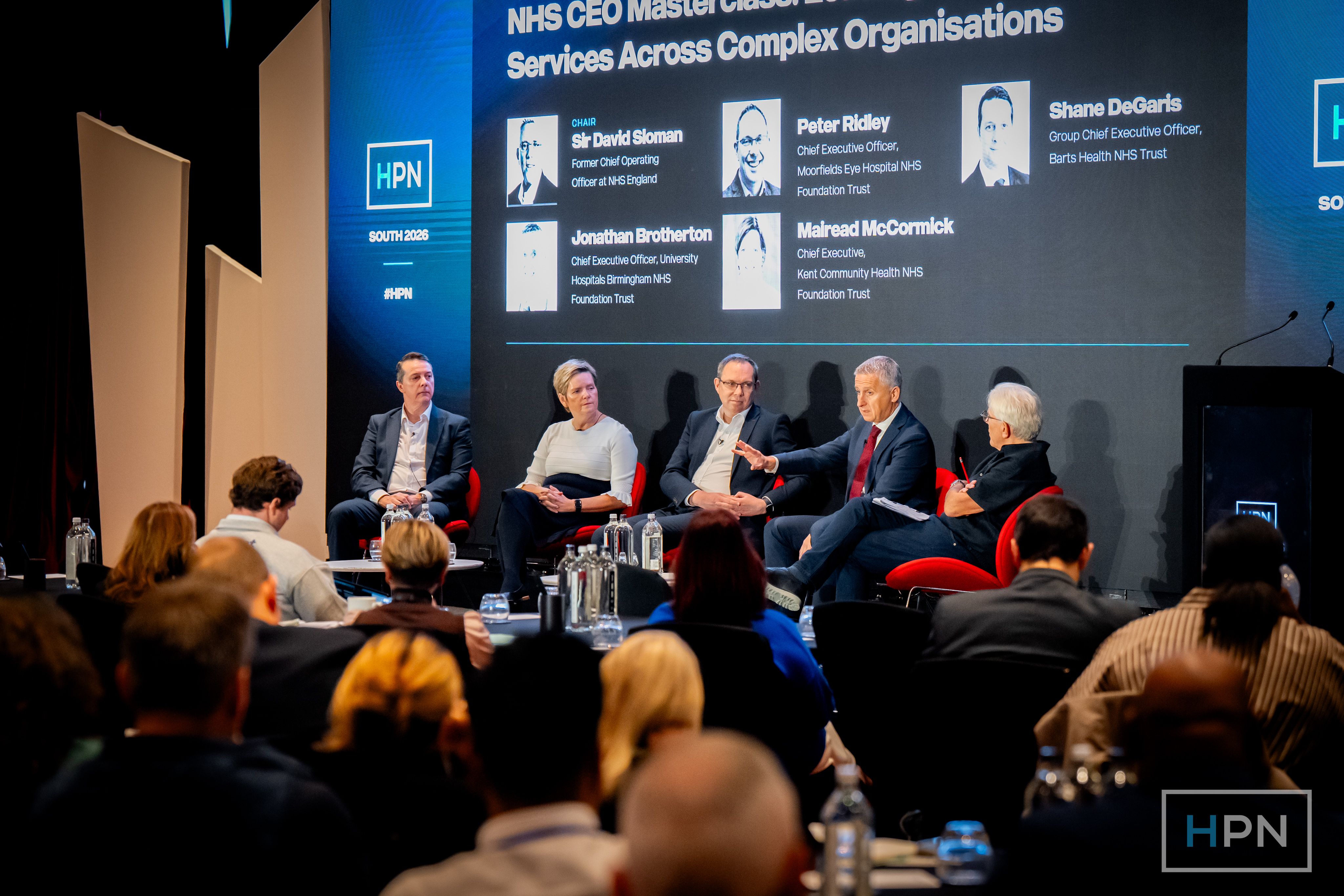
At HPN South, Sir David Sloman brought together four NHS chief executives to explore what it takes to lead services across large, complex organisations. Jonathan Brotherton of University Hospitals Birmingham, Shane DeGaris of Barts Health, Peter Ridley of Moorfields and Mairead McCormick of Kent Community Health shared experiences spanning acute, specialist and community care, multiple sites and, in McCormick’s case, a major integration completed less than two weeks before the session.
Their organisations vary considerably, but a clear message ran through the discussion: successful leadership at scale is less about creating the perfect structure and more about knowing when to standardise, when to devolve and how to maintain local connection as organisations continue to change.
Scale can bring financial leverage, shared expertise and more consistent standards. But the session also highlighted what can happen when integration goes too far and staff lose their connection to the hospital, service and leaders they identify with.
That tension came into sharp focus when Brotherton reflected on University Hospitals Birmingham’s experience of bringing services together under a single leadership structure. The logic was difficult to argue with, but its practical impact was very different.
"You couldn't argue with the logic, but the practical application absolutely destroyed the culture of the organisation because people lost connection."
Jonathan Brotherton
Scale fails when people lose their connection
Brotherton described UHB as the product of several mergers by acquisition. Its previous model attempted to create large specialties operating across every hospital under single leadership. The aim was consistency, but staff felt decisions were being made for them rather than with them. They lost local control, relationships with management weakened and the culture deteriorated.
The recovery began by reconnecting people with the places they recognised: their hospital, service and department. Leadership was moved closer to sites and teams were given more control over the frustrations they faced. Staff survey results and performance across quality, safety, operations and finance began to improve alongside the cultural shift.
Barts Health has followed a similar principle for longer. Group leaders set overall strategy, corporate services are shared where that makes sense, and clinical networks tackle unwarranted variation. Each hospital still has its own chief executive and leadership team, with responsibility for staff and local partnerships.
"What you want is a healthy tension between the group and the hospitals. There is an ever-moving sweet spot. You can devolve too much or you can centralise too much."
Shane DeGaris
That 'sweet spot' is not fixed. Services that were once devolved may need to come back together if variation grows; others may perform better with greater local freedom. DeGaris argued that leaders need principles against which to test those decisions, rather than treating centralisation or devolution as a permanent ideology.
One standard does not require one way of working
Even within a single specialty, reducing variation is difficult. Moorfields delivers only ophthalmology, but across sites with different histories, cultures and relationships with host trusts. Ridley noted the challenge of asking genuinely world-leading clinicians to standardise when each can reasonably claim deep expertise in how their service should operate.
The answer is not to abandon consistency. It is to involve clinicians in defining the right pathway and distinguish between what must be standardised and what genuinely needs to be integrated. Sir David reflected that A&E departments across three hospitals may never operate as one service, while a specialist renal pathway might benefit from full integration. Treating both in the same way is where apparently tidy models begin to break down.
Digital infrastructure can help hold a dispersed organisation together. Moorfields uses virtual urgent care, central referral and triage systems and new workforce models across its sites. Around 70,000 referrals are triaged annually, with 40% directed somewhere other than the original destination and urgent cases identified earlier. Technology creates consistency in the pathway without requiring every site to look identical.
Shifting care requires more than shifting demand
Mairead McCormick highlighted one of the central challenges facing leaders looking to move more care out of hospital. The neighbourhoods most ready to take on additional responsibility are often the best resourced, while areas with the greatest need may also have the deepest workforce pressures and least mature infrastructure.
"We're going to have to redistribute resources and load the areas that are least mature - and that's going to be noisy."
Mairead McCormick
That imbalance sits at the heart of the wider pressure created by rising demand. At Barts Health, DeGaris said around 100 more patients are arriving each day than during the same period the previous year. Brotherton described acute services overwhelmed by activity that does not necessarily need to take place in hospital. Both are moving resources into community, primary care and home-based support.
But the phrase ‘shift left’ risks sounding deceptively simple. DeGaris argued that resource cannot simply be transferred upstream in the hope that new capacity appears. Acute, primary and community partners need transition plans and shared arrangements for risk and reward.
This is where system leadership becomes political as well as operational. Improving equity may mean taking resource from a service that appears to be coping and moving it to a community that is not. Leaders need to explain why, create stability through collaboration and accept that meaningful redistribution will rarely be comfortable.
Staff experience is operational intelligence
Sir David said the staff attitude survey was the indicator most closely correlated with high-performing trusts during his time overseeing NHS organisations nationally. The panellists treated that insight as more than an HR measure. It was a way of understanding whether a complex operating model was working in practice.
At Moorfields, a breakdown in communication and the absence of clinical voices from key decisions contributed to a no-confidence letter to the then board from consultants. Ridley said the recovery has involved transparency, listening and giving clinicians enough information to understand what the organisation is trying to achieve - including space to disagree.
McCormick visits a service every week and still works clinically once a month. Brotherton also spends time each week with clinical, corporate and support teams, describing contact with staff doing real jobs as the thing that restores his energy. Across the panel, visibility was not presented as a ceremonial walkaround. It was how leaders test whether strategy survives contact with the frontline.
Boards need to see more than a snapshot
An audience question challenged the leaders on how they keep boards with them when strategy changes direction. Ridley's answer captured the information gap that can develop between executives immersed in delivery and non-executives who encounter the organisation at intervals.
"The non-executives see a series of stills. We see the whole movie. The question is how you fill in those blanks and make sure you are taking people with you."
Peter Ridley
Good strategy therefore needs fixed points as well as assumptions that can be revisited. Non-executives can be particularly valuable in asking whether an organisation is still solving the problem it originally set out to address. But they can only do that well if leaders share the journey from the first idea through to implementation, rather than presenting a polished decision at the end.
The chief executive cannot become the system
The final part of the discussion turned to the leaders themselves. Each described the value of staying connected to life outside the executive role, whether through music, cycling, family, clinical work or simply spending time with staff. The point was not lifestyle advice. In jobs defined by complexity and constant pressure, the condition of the leader affects the condition of the organisation.
DeGaris offered a practical rule: leaders should focus on the things only they can do. Brotherton described learning to admit when he did not understand something and ask for help. McCormick spoke about collaboration rather than competition. Ridley reflected on the need to stop proving he could work as hard as everybody else and instead create the conditions in which others can succeed.
"I genuinely think an organisation is as good as the physical and mental health of its chief executive. Looking after yourself is profoundly important."
Sir David Sloman
The masterclass did not produce one model for running a complex NHS organisation. It offered a more useful set of tests. Does scale increase capability without taking away local identity? Are standards improving care or merely creating uniformity? Is resource moving with responsibility? Can staff still influence the people making decisions?
The leaders who manage complexity best may not be those with the neatest structures. They may be those willing to keep adjusting the balance - and honest enough to recognise when the model itself has become part of the problem.
Join the next discussion at HPN North
If you missed this discussion at HPN South, your next opportunity to join the conversation is HPN North on 29 and 30 April 2027 at The Manchester Deansgate.
Chaired by Mark Cubbon, Chief Executive Officer at Manchester University NHS Foundation Trust, the event will feature NHS chief executives including Salman Desai KAM of North West Ambulance Service NHS Trust and Chris Oliver of Greater Manchester Mental Health NHS Foundation Trust.
Together with other senior NHS and ICS leaders, they will explore the leadership, operational and workforce challenges shaping complex organisations and system-wide change. Applications are open for complimentary delegate places, subject to approval.